
NeoCell Super Collagen Peptides: Type 1 & 3 Collagen for Skin, Hair, and Nails

skin & Wellness Science | 7 min read
Introduction — Not All Collagen Is the Same
Here’s something most supplement labels never tell you: there are 28 known types of collagen in the human body.[1] Yet when you scan the ingredients of a typical collagen powder, you’ll usually see just one or two mentioned — most often Type 1 and Type 3. That’s not a shortcut. It’s a deliberate choice, and understanding why can completely change how you shop for a collagen supplement.
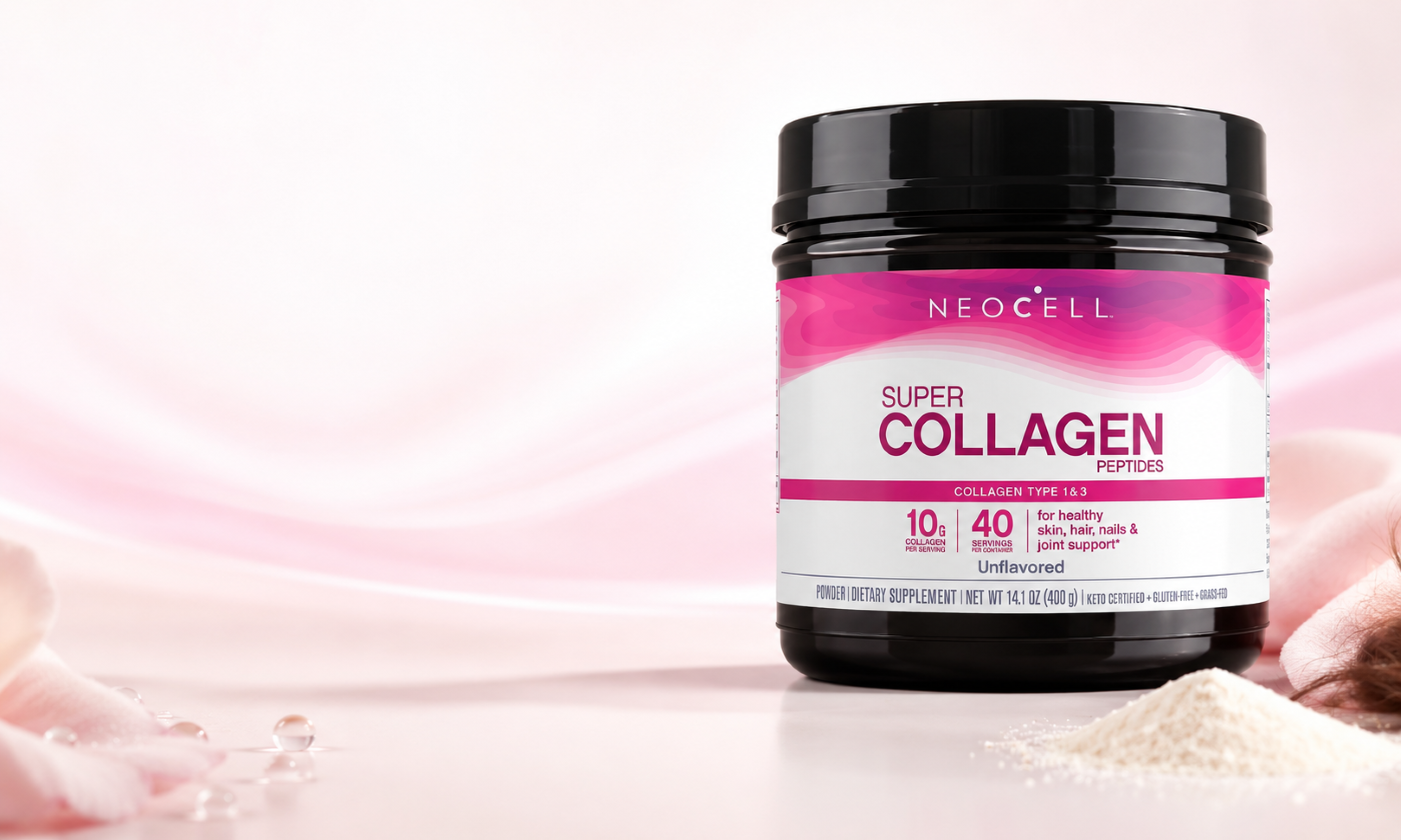
In this article, we’ll break down what collagen actually is, why Type 1 and Type 3 are the dominant forms in your skin, hair, and nails, why Type 2 serves a completely different purpose, and how a formula like NeoCell Super Collagen Peptides is built around this science rather than around marketing trends.
Quick Look: If your goal is firmer skin, stronger hair, and healthier nails, you want Type 1 & 3 collagen. If your goal is joint comfort and cartilage support, Type 2 is the more relevant category. Most beauty-focused powders — including NeoCell — are formulated around the first group.
What Is Collagen, Really? A Quick Science Primer
The Body’s Most Abundant Protein
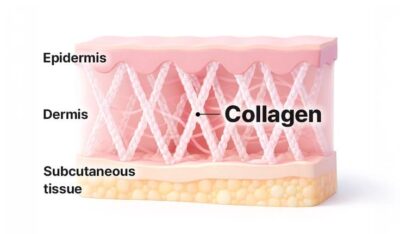
Collagen makes up roughly a third of all protein in the human body.[2] It’s the structural scaffolding that holds skin, tendons, ligaments, bones, and connective tissue together. Think of it as the mesh underneath your skin’s surface — when that mesh is dense and well-supported, skin appears plump and resilient. When it thins, fine lines and sagging become more visible.
Why Collagen Production Declines With Age
Natural collagen synthesis begins slowing as early as the mid-to-late twenties, and research published in the American Journal of Pathology found that fibroblasts — the cells responsible for producing collagen — become progressively less efficient with chronological age, with type I procollagen production measurably reduced in older skin compared to skin from adults in their twenties.[3] Sun exposure, stress, poor sleep, and diet can accelerate this decline further, which is the core reason collagen supplementation has become such a widely discussed topic in skin and wellness circles.
The Main Collagen Types Found in Supplements
Type 1 Collagen — The Structural Powerhouse
Type 1 is the most abundant collagen in the human body, found densely in skin, tendons, bones, and blood vessels.[4] It’s largely responsible for skin firmness and elasticity, which is why it’s the anchor ingredient in nearly every reputable beauty-collagen formula.
Type 2 Collagen — The Cartilage Specialist
Type 2 collagen is concentrated almost exclusively in cartilage — the cushioning tissue found in joints — and is one of the main structural collagens studied in joint and cartilage research.[5] It plays a very different structural role than Type 1 and is generally the type researched in relation to joint comfort and mobility, rather than skin or hair.
Type 3 Collagen — The Support System
Type 3 is often found working alongside Type 1, particularly in skin, blood vessels, and organ tissue.[4] It contributes to skin’s flexibility and is thought to support the overall network that Type 1 builds — the two are frequently discussed together for exactly this reason.
Why NeoCell Chose Type 1 & 3 (Not Type 2)
The Skin-Hair-Nail Connection
Skin, hair, and nails share overlapping structural proteins, and Type 1 & 3 collagen are central to that shared network. A formula built specifically around these two types is designed to support the visible, everyday concerns most people reach for a collagen supplement in the first place — texture, elasticity, and strand or nail strength.
How Type 1 & 3 Work Together in the Body
Rather than functioning in isolation, Type 1 and Type 3 collagen are often described as complementary — Type 1 provides the dense structural fiber, while Type 3 supports flexibility around it.[1] Supplementing with both together mirrors how they naturally occur side by side in skin tissue.
Why Type 2 Serves a Different Purpose (Joints & Cartilage)
This is where formulation intent matters. A joint-support supplement built around Type 2 collagen is solving a different problem than a beauty-focused one.[5] Neither is “better” — they’re simply engineered for different goals, which is why checking the collagen type on a label matters more than checking the total collagen amount.
Shop This Article
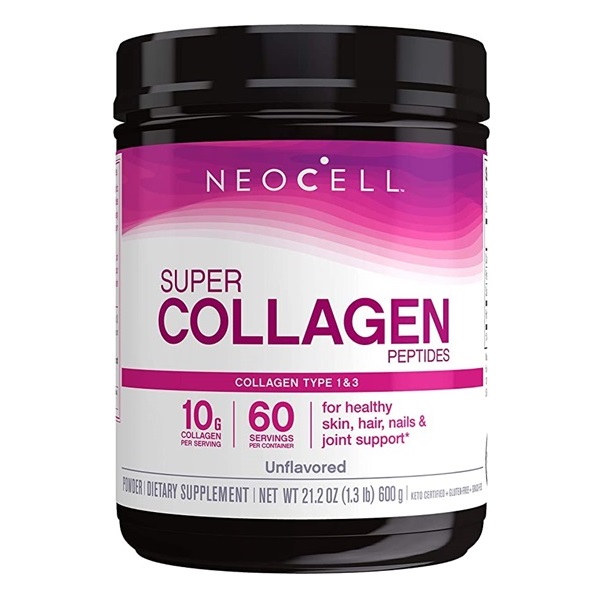
NeoCell Super Collagen Peptides, Grass-Fed, 21.2oz
Grass-fed Type 1 & 3 collagen for skin, hair, and nails.
NeoCell Super Collagen Peptides Powder, 400g
Hydrolyzed Type 1 & 3 collagen for firmer skin, stronger hair.
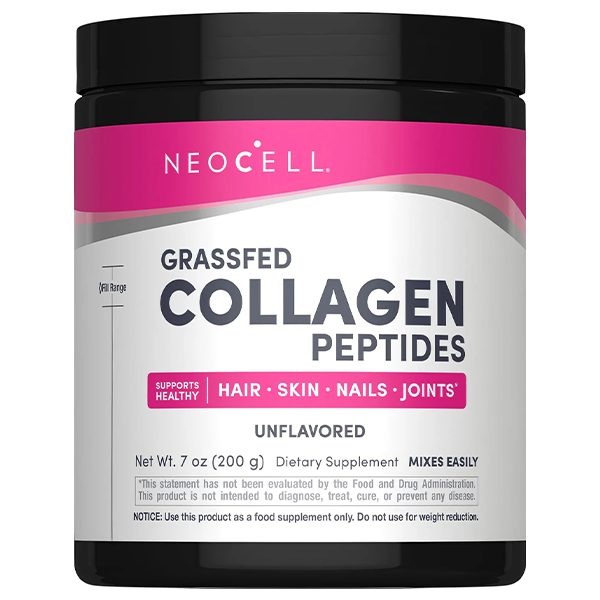
Neocell Grassfed Collagen Peptides, 200g
Same Type 1 & 3 formula in a travel-friendly size.
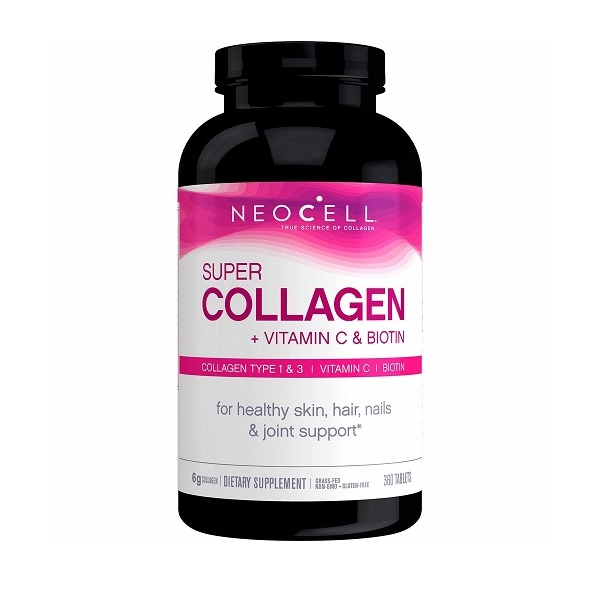
Inside NeoCell Super Collagen Peptides — The Formula Breakdown
Hydrolyzed Collagen: Why Peptide Size Matters for Absorption
NeoCell's formula uses hydrolyzed collagen, meaning the protein has been broken down into smaller peptide chains before packaging. Clinical research on collagen hydrolysates has confirmed that these smaller peptides, including hydroxyproline-containing di- and tripeptides, are measurably absorbed into the bloodstream after oral intake.[6]
Bovine Sourcing and What It Means for Type 1 & 3 Content
The formula is sourced from bovine collagen, a naturally rich source of Type 1 & 3 collagen specifically. This sourcing choice aligns directly with the skin, hair, and nail focus of the product, rather than the cartilage-heavy composition you'd expect from a marine or chicken-sourced Type 2 formula.
Serving Size, Dosage, and What 10g Actually Delivers
A standard daily serving delivers a concentrated dose of Type 1 & 3 collagen peptides, formulated to fit easily into a daily routine without requiring multiple servings or complicated timing. A randomized, controlled clinical trial evaluating a daily hydrolyzed collagen supplement over 56 days reported measurable improvements in skin moisturization, elasticity, and wrinkle depth compared to a placebo group.[7]
Who Benefits Most From a Type 1 & 3 Formula?
People Focused on Skin Elasticity and Hydration
If your main interest is skin that looks and feels firmer over time, Type 1 & 3 collagen is the more relevant category to look for on a label.
Those Targeting Hair and Nail Strength
Because hair and nails share structural similarities with skin at a cellular level, the same Type 1 & 3 profile that supports skin is typically the one associated with hair and nail-focused goals as well.
When You Might Want Type 2 Instead (Joint-Focused Needs)
If your primary concern is joint comfort rather than skin or hair, a Type 2-based cartilage formula would be the more appropriate category to research, as it targets a different tissue system entirely.[5]
How to Use It: Practical Integration Tips
Mixing Into Coffee, Smoothies, and Recipes
NeoCell's collagen peptides are unflavored and dissolve easily, making them simple to stir into coffee, smoothies, oatmeal, or soups without altering taste or texture — a practical feature for building a sustainable daily habit.
Consistency Over Quantity — What Research Says About Timing
Collagen supplementation is generally discussed as a long-term, consistency-driven habit rather than something with immediate results. Clinical studies most commonly evaluate daily use over eight or more weeks before measuring changes in skin or connective tissue markers, rather than occasional or high-dose use.[7]
"Formulating around a specific collagen type isn't a marketing detail — it's the difference between a product built for a purpose and one built for a label."
Conclusion — Choosing Collagen With Intention
Type-specific formulation isn't a gimmick — it reflects how collagen actually behaves in the body. Type 1 & 3 collagen is built for skin, hair, and nails, while Type 2 is built for joints and cartilage, and understanding this distinction is the simplest way to choose a supplement that actually matches your goal.
If your focus is on skin, hair, and nail support, NeoCell Super Collagen Peptides is formulated specifically around that Type 1 & 3 profile, using hydrolyzed bovine collagen designed for daily use.
Sources
[1] Ricard-Blum S. The Collagen Family. Cold Spring Harbor Perspectives in Biology, 2011. View source
[2] Silvipriya K.S. et al. Collagen: Animal Sources and Biomedical Application. Journal of Applied Pharmaceutical Science. View source
[3] Varani J, et al. Decreased Collagen Production in Chronologically Aged Skin. American Journal of Pathology, 2006. View source
[4] A Comprehensive Review on Collagen Type I Development of Biomaterials for Tissue Engineering. Bioengineering (MDPI), 2022. View source
[5] Main and Minor Types of Collagens in the Articular Cartilage. PMC. View source
[6] Absorption of Bioactive Peptides Following Collagen Hydrolysate Intake. Frontiers in Nutrition, 2024. View source
[7] Evaluation of the Efficacy of a Hydrolyzed Collagen Supplement for Improving Skin Moisturization, Smoothness, and Wrinkles. PMC. View source